St Giles' Cathedral
St Giles' Cathedral is the High Kirk of Edinburgh, on the Royal Mile in Edinburgh's Old Town. Visitors aged 16 and over from outside Scotland pay £12, with the Thistle Chapel and guided tours included; residents of Scotland and under-16s go in free. It opens at 10:00 on weekdays, 09:00 on Saturdays and 13:00 on Sundays.
Updated
Key facts
- Visitor ticket
- £12Aged 16 and over, from outside Scotland
- Free entry
- Residents of ScotlandWith a Resident Pass; under-16s free with an adult
- Opening hours
- 10:00 to 18:00Weekdays; Saturday from 09:00, Sunday from 13:00
- Last admission
- One hour before closing
- Access ticket
- £10With a free Companion Pass
- Tours
- IncludedGuided tours and a phone audio tour; no roof tour
- Step-free entrance
- West DoorThe main entrance, by ramps
- Walk
- 5 min on footFrom Waverley's Market Street exit; 9 min on foot from the castle
Tickets and who goes in free
Visitors aged 16 and over who do not live in Scotland need a ticket. It covers the cathedral floor, the Thistle Chapel, the guided tours and the audio tour, and it stays valid for 12 months. Booking ahead gets you fast-track entry.
A ticket is for a date and time you choose. You can change the time online, but a ticket cannot be cancelled. There is no concession or student discount.
| Ticket | Price |
|---|---|
| Visitor ticket, 16 and over | £12 |
| Access ticket | £10, with a free Companion Pass |
| Group ticket, 7 or more | £7.50 each |
| Resident Pass, residents of Scotland | Free |
| Under 16, with an adult | Free |
Prices shown in November 2026.
Who goes in free or pays less
Residents of Scotland
Free with a Resident Pass. Register online, then bring a proof of address at the start of your first visit to activate it. The pass lasts 365 days.
Under-16s
Free, with an adult who holds a Visitor ticket, an Access ticket or a Resident Pass, or with a group.
Visitors with access needs
The Access ticket costs £10. A companion, carer or personal assistant goes free on a Companion Pass booked with it.
Opening times and last admission
| Day | Opens | Last admission | Closes |
|---|---|---|---|
| Monday to Wednesday | 10:00 | 17:00 | 18:00 |
| Thursday | 10:00 | about 16:00 | about 17:00 |
| Friday | 10:00 | 17:00 | 18:00 |
| Saturday | 09:00 | 16:00 | 17:00 |
| Sunday | 13:00 | 16:00 | 17:00 |
On Saturdays the first hour, 09:00 to 10:00, is a Quiet Hour, kept calm for visitors who find noise, light and crowds hard. No flash photography is allowed then.
Sunday mornings are for worship, with Holy Communion and Morning Worship, so visiting starts at 13:00.
Guided tours and the audio tour
Guided tours
Guided tours run two times a day on weekdays and on Saturday mornings, and the ticket includes them. They stay in the main body of the cathedral, all on one level; only the Thistle Chapel is down some steps.
Digital visitor guide
A digital guide with an interactive map opens on your phone when you scan the QR code at the Welcome Desk. It is in English, French, Gaelic, Portuguese, Spanish, Ukrainian, German, Mandarin, Italian and Japanese.
Audio tour
The audio tour takes 25 minutes and plays on your own smartphone from a QR code, in English, German and Ukrainian. It needs 25MB of space, and headphones help. Every ticket includes it.
What to see: the crown steeple, the Thistle Chapel and the windows
The crown steeple
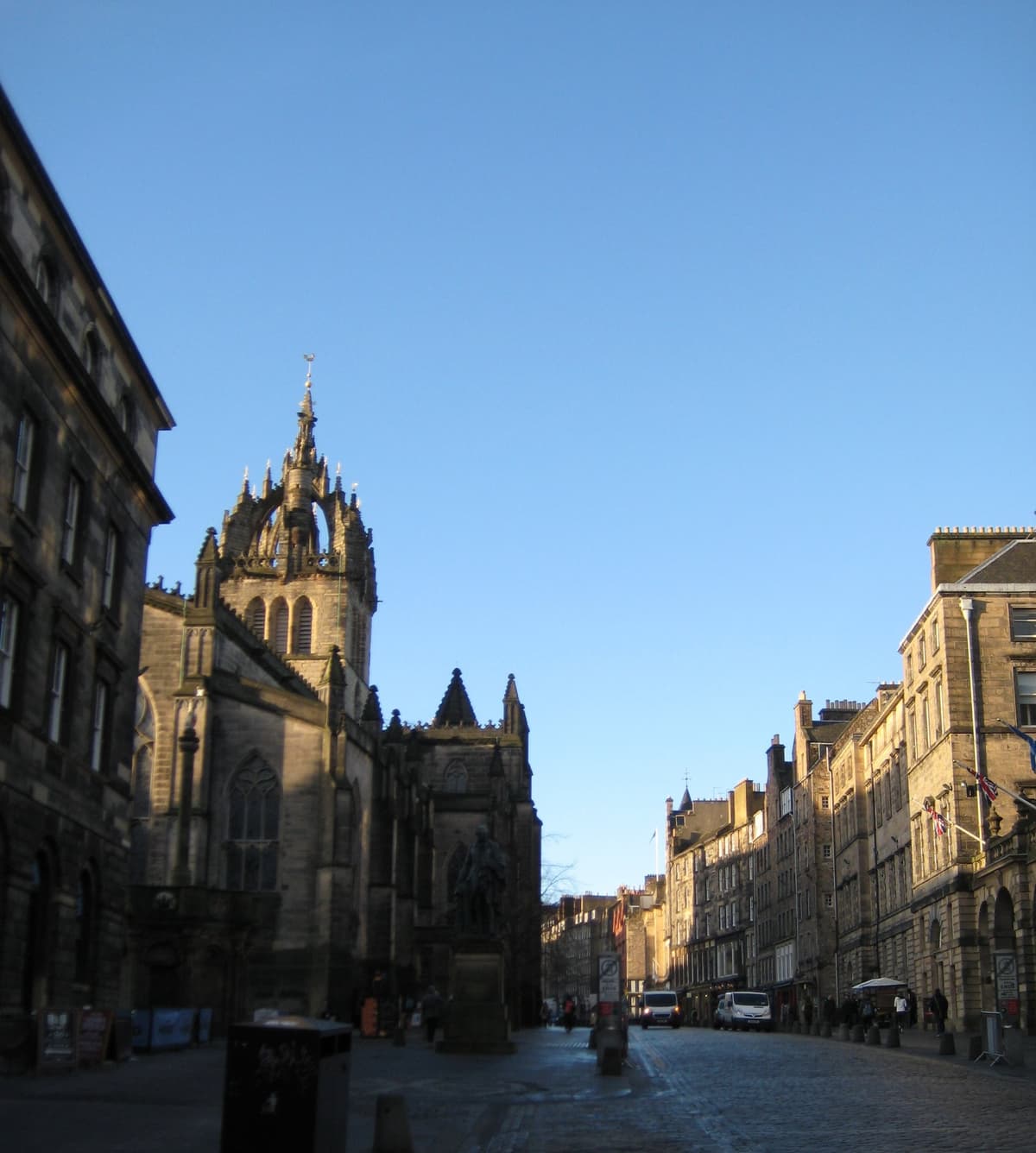
The crown on the tower dates from the 15th century and stands on eight flying buttresses. John Mylne rebuilt it in 1648.
The Thistle Chapel
Robert Lorimer designed the chapel of the Order of the Thistle, Scotland's great order of chivalry, and it was finished in 1911. It holds stalls for the 16 knights, the Sovereign's stall and two Royal stalls, and among its carvings are angels playing bagpipes. The wrought iron is by Thomas Hadden, the heraldic stained glass by Louis Davis.
The order as it is today was largely created by James VII in 1687, and appointments to it are the Sovereign's own gift.
- four steps at the entrance; a video or a guide for visitors who cannot use them
The windows
The great west window is the Robert Burns memorial window, installed in 1985. In the west wall of the north nave aisle, a window designed by Edward Burne-Jones and made by Morris & Co. dates from 1886.
The memorials
Augustus Saint-Gaudens made the large bronze relief of Robert Louis Stevenson on the west wall of the Moray Aisle. The monuments to the rivals James Graham, Marquess of Montrose, in the Chepman Aisle (1888), and Archibald Campbell, Marquess of Argyll, in the St Eloi Aisle (1895), each hold a life-size effigy in alabaster and marble.
Jenny Geddes' stool
In 1637 people rioted in St Giles' against an English-style prayer book that Charles I meant to introduce. Legend has it that when Dean James Hannay began to read from it, Jenny Geddes threw her folding stool at his head. A woman of that name did live then, but no evidence proves the throw. In 1992 a group of Scotswomen gave the cathedral a bronze of her three-legged stool by Merilyn Smith.
Photos, bags, dogs and wheelchair access
No food or drink
Only bottled water is allowed inside.
No luggage storage
There is no cloakroom, so keep your bags with you.
No photos of people
Photos and video of the building are fine for personal use, but not of other visitors, staff or volunteers, and not during services.
There is no strict dress code; St Giles' asks visitors to be respectful in a church in use. Dogs are allowed in.
The West Door is the main entrance and is step-free, with a ramp up to it and another just inside. The Thistle Chapel has four steps, and the shop and some side aisles are also up steps. Works to make the whole cathedral reachable by wheelchair are planned to finish in early 2027. There are two manual wheelchairs to borrow and a hearing loop.
St Giles' has no accessible toilet. The nearest are in the National Library of Scotland on George IV Bridge, on its ground and first floors.
Getting there
The cathedral's address is High St, EH1 1RE. It stands on the High Street beside the Mercat Cross and Parliament Square, and the Royal Mile runs past its door from the castle down to the palace.
From the castle
From the castle gatehouse it is 630 m down Castlehill, the Lawnmarket and the High Street: 9 min on foot.
From Waverley station
From the station's Market Street exit it is 370 m, uphill: 5 min on foot.
By bus
The nearest stop is Victoria Street on George IV Bridge, and buses from across the city run to South Bridge, further down the Royal Mile.
By car
The cathedral has no parking. Two Blue Badge bays behind it, by the Mercat Cross, cannot be booked. The car parks of the Old Town are a walk away.
- St Giles' CathedralThe way in is the West Door.
- Mercat CrossBeside the cathedral; the Blue Badge bays are here.
- John Knox's graveA marker shows the presumed site.
- George IV BridgeThe Victoria Street bus stop and the National Library.
- Waverley, Market Street exit5 min on foot to the cathedral, uphill.
Why a cathedral with no bishop
St Giles' is the High Kirk of Edinburgh, a Church of Scotland congregation worshipping in the Presbyterian tradition. It became a cathedral in 1633, when Charles I created a diocese of Edinburgh with St Giles' as its seat. Bishops were abolished in 1638, restored in 1660 and abolished for good in 1690. St Giles' kept the title, as Glasgow and Dunblane did.
Edinburgh has two other cathedrals. St Mary's Episcopal Cathedral on Palmerston Place, designed by George Gilbert Scott and dedicated in 1879, is the seat of the Scottish Episcopal Church's Bishop of Edinburgh. St Mary's Catholic Cathedral is on Broughton Street.
About 1124
St Giles' is founded by King Alexander I or his brother King David I. It is named after a hermit who, by legend, lived near Nîmes in the 7th century.
1385
The church is rebuilt after a raid. Through the Middle Ages it is the only parish church inside the city walls.
1455
The Preston Aisle is built in memory of Sir William Preston, who left the church an arm bone believed to be a relic of St Giles.
1633
St Giles' becomes the cathedral of the new diocese of Edinburgh.
By 1699
Partitions divide the inside into four separate churches.
1829 to 1833
William Burn refaces the outside in smooth stone.
1883
The Lord Provost William Chambers and the architect William Hay finish a restoration that makes it one church again.
1911
The Thistle Chapel is finished.
2022
On 12 September 2022 the coffin of Queen Elizabeth II is brought here for a service of thanksgiving and lies at rest for 24 hours.
2023
On 5 July 2023 the Honours of Scotland are presented to King Charles III here.
John Knox's church and his grave
John Knox, born in Haddington, came back from exile in Geneva to lead Scotland's Protestant lords, and Scotland became an officially Protestant country in 1560. As minister of St Giles' he preached against Mary, Queen of Scots, and he served here until he died on 24 November 1572. A life-size bronze of him by James Pittendrigh MacGillivray, from 1906, stands in the north nave aisle.
Knox was buried in St Giles' burial ground, which was destroyed in 1633, so the exact site of his grave cannot be established. A marker in Parliament Square, a little west of the statue of Charles II, shows the presumed site, 2 min on foot from the Mercat Cross. How the Reformation changed the town is part of the Old Town's history.
Music and services
St Giles' is a church in use. Its services include Holy Communion and Morning Worship on Sunday mornings and Choral Evensong on Thursdays, led by the cathedral choir and the Rieger organ. Photography and filming are not allowed during a service.
Recitals and concerts run through the week in regular series: St Giles' at Six, the Chamber Music Series, St Giles' Sessions and St Giles' Spotlight. The cathedral's Christmas services are part of Christmas in Edinburgh.
Frequently asked questions
Is St Giles' Cathedral free to visit?
Not for everyone. Visitors aged 16 and over from outside Scotland pay £12. Residents of Scotland go in free with a Resident Pass, and under-16s go free with an adult.
Is St Giles' Cathedral Protestant or Catholic?
Protestant. St Giles' is a Church of Scotland congregation in the Presbyterian tradition, the High Kirk of Edinburgh. John Knox was its minister during the Reformation.
How many cathedrals are there in Edinburgh?
Three: St Giles', the High Kirk; St Mary's Episcopal Cathedral on Palmerston Place, of the Scottish Episcopal Church; and St Mary's Catholic Cathedral on Broughton Street.
Can you go up the roof or tower of St Giles'?
No. The cathedral offers no roof tour. Its tours are the guided tours on the cathedral floor and the audio tour, and both are in the ticket.
Can you take photos inside St Giles'?
Yes, of the building and its contents, for personal use. Photos of other visitors, staff or volunteers are not allowed, and nothing may be filmed or photographed during a service.
Where is John Knox buried?
In St Giles' old burial ground, in what is now Parliament Square. The burial ground was destroyed in 1633, and a marker a little west of the statue of Charles II shows the presumed site of his grave.