Royal Mile
The Royal Mile is the main street of Edinburgh's Old Town. It runs from Edinburgh Castle down to the Palace of Holyroodhouse as six streets in a row: the Esplanade, Castlehill, the Lawnmarket, the High Street, the Canongate and Abbey Strand. It is 1.6 km long, 23 min on foot downhill without stops, with closes leading off both sides.
Updated
Key facts
- Length
- 1.6 kmFrom the castle gatehouse to the palace gates
- Walking time
- 23 min on footWithout stops, downhill from the castle
- The name
- A Scots mile1,976 yards; an English mile is 1,760
- The streets
- six in a rowEsplanade, Castlehill, Lawnmarket, High Street, Canongate and Abbey Strand
- Height
- 107 m to 37 mAbove the sea, rounded; the Esplanade to the palace
- No cars
- By St Giles'The High Street from Parliament Square to Cockburn Street
- Road works
- Until 30 June 2027The lower High Street and St Mary's Street, closed to vehicles in phases
- Cost
- Free to walkFree museums and paid sights along the way
The Royal Mile from end to end
From the castle gatehouse to the palace gates the Royal Mile is 1.6 km by the shortest walk, 23 min on foot without stops. It falls from about 107 m above the sea at the Esplanade to about 37 m at the palace, so it is easiest walked from the castle down.
Castlehill, the narrow top, opens into the broader Lawnmarket, which ends at the crossroads with George IV Bridge and Bank Street. From there the High Street, the broadest and longest street of the Old Town, runs on to St Mary's Street. Below it the Canongate, a separate burgh until 1856, runs down to Abbey Strand and the palace.
The name comes from the Scots mile of 1,976 yards, longer than the English mile of 1,760. "Royal Mile" was coined in the late 19th century and came into wide use in the early 20th.
| Part | Length | Starts from the castle |
|---|---|---|
| Esplanade | 120 m | At the gatehouse |
| Castlehill | 130 m | 120 m |
| Lawnmarket | 170 m | 250 m |
| High Street | 500 m | 420 m |
| Canongate | 660 m | 920 m |
| Abbey Strand | 60 m | 1,580 m |
Lengths along the street, rounded.
The Palace of Holyroodhouse, the foot
- 1Castle Esplanade, South side
- 2Camera Obscura, North side
- 3The Hub, South side
- 4Gladstone's Land, North side
- 5St Giles' Cathedral, South side
- 6City Chambers, North side
- 7Tron Kirk, South side
- 8Museum of Childhood, South side
- 9John Knox House, North side
- 10Museum of Edinburgh, South side
- 11Canongate Kirk, North side
- 12Scottish Parliament, South side
- 13White Horse Close, North side
- 14Palace of Holyroodhouse, South side
Edinburgh Castle, the top of the Royal Mile
Castlehill and the Esplanade
Castle Esplanade
The open ground in front of the castle gatehouse was laid out as a parade ground in 1753, with earth dug out for the Royal Exchange, now the City Chambers. The Tattoo is staged on it every August.
Witches' Well
A memorial drinking fountain at the lower end of the Esplanade stands close to where many people accused of witchcraft were burned. Patrick Geddes commissioned it in 1894, and John Duncan designed it.
Cannonball House
The story goes that the cannonball in the wall of Cannonball House, facing the Esplanade, was fired from the castle. It marks the height of the Comiston Springs.
The Hub
The Hub, on the south side of Castlehill, is the home and a venue of the Edinburgh International Festival, held every August with the Fringe.
Camera Obscura & World of Illusions, at 549 Castlehill, has 98 steps to its rooftop and no lift. Entry is paid, in timed slots booked online, with tickets on the day if any are left.
The Lawnmarket and Deacon Brodie
Gladstone's Land
Gladstone's Land, at 477B Lawnmarket, is a six-storey tenement of the early 17th century, built of dressed stone, with hand-painted ceilings from 1620. Entry is paid. It is closed from 24 December 2026 to 7 January 2027.
Writers' Museum
Down Lady Stair's Close, the Writers' Museum fills Lady Stair's House, a 17th-century town house, with portraits, rare books and belongings of Robert Burns, Sir Walter Scott and Robert Louis Stevenson. It is free and open every day. Among Stevenson's things is a wardrobe made by Deacon Brodie.
Deacon Brodie
William Brodie was born in Edinburgh on 28 September 1741, the son of a wright. In September 1781 he joined the Town Council as Deacon of the Incorporation of Wrights, the trade guild of the cabinet-makers and joiners, and he led a secret life as a burglar.
Brodie's Close, named after his family's home, once ran down to the Cowgate; only its upper part survives. The pub at the corner of the Lawnmarket and Bank Street carries his name.
David Hume statue
Alexander Stoddart's bronze of the philosopher David Hume, 3 m tall, stands outside the High Court. The Saltire Society commissioned it for its 60th anniversary, and it was unveiled on 30 November 1997. The big toe of the right foot shines where people rub it for luck, students above all before exams.
Brodie's trial and his gallows
Brodie and George Smith were tried for robbing the General Excise Office for Scotland, then in Chessel's Court on the Canongate. The trial began on 27 August 1788, and both men were hanged on 1 October 1788 before a large crowd.
The story goes that Brodie died on a gallows he had designed himself. In 1784 the council asked him and two other deacons to report on a door in the Tolbooth's west wall, so that executions could move there from the Grassmarket.
Robert Louis Stevenson drafted a play about him as early as 1864, which became "Deacon Brodie, or the Double Life", written with W. E. Henley. The Writers' Museum says Brodie's double life may have inspired Stevenson's "Strange Case of Dr Jekyll and Mr Hyde".
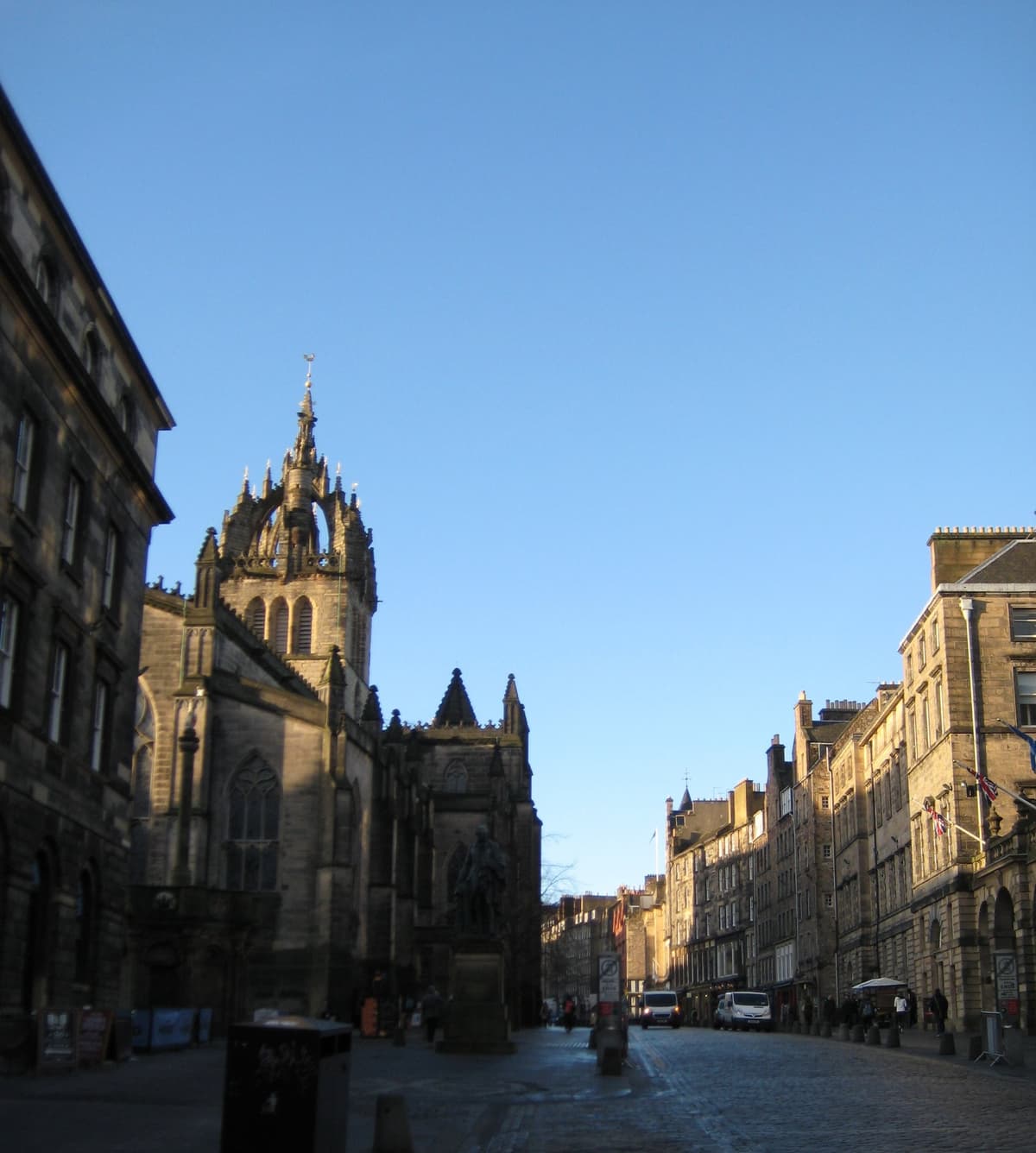
Parliament Square and St Giles'
St Giles' Cathedral stands on the south side of the High Street, with Parliament Square around it. Visitors aged 16 and over from outside Scotland pay; residents of Scotland and under-16s go free. The step-free way in is the West Door.
Heart of Midlothian
By St Giles' West Door, a heart set into the paving marks the entrance of the Old Tolbooth. A tolbooth was the burgh's building where tolls were collected and the town was run; this one was later a prison and a place of execution, and was pulled down in 1817. Locals spat on the heart in contempt for the prison; folklore says spitting on it brings luck.
Mercat Cross
The Mercat Cross beside St Giles' is where royal and parliamentary proclamations for all of Scotland were read, and heralds still announce a new monarch and general elections there. It has stood on its present base since 1885; an octagon of setts in the High Street marks where it stood from 1617.
John Knox's grave
John Knox, minister of St Giles', died on 24 November 1572 and was buried in the kirkyard beside it, which no longer exists. A stone in the road of Parliament Square, a little west of the statue of Charles II on horseback, marks the presumed site of his grave. The statue was put up soon after the king's death in 1685.
Parliament House
Behind St Giles', Parliament House is the seat of the Court of Session. Its Parliament Hall was the home of the Parliament of Scotland from 1639 to 1707 and is now a meeting place for lawyers. Courtrooms are generally open to the public to attend and listen, though some hearings are closed.
City Chambers
Across the High Street, the City Chambers were built from 1754 to 1761 as the Royal Exchange, to a design by John Adam. Mary King's Close lies beneath them, and The Real Mary King's Close takes visitors down on a paid guided tour of one hour, from the age of 5.
Adam Smith statue
Stoddart's bronze of the economist Adam Smith, life and a half size, stands in the High Street by St Giles'. It was unveiled on 4 July 2008. Smith is buried further down, in the Canongate kirkyard.
From the Tron Kirk to the World's End
Tron Kirk
The Tron Kirk was built from 1637 to 1647 to a design by John Mylne and held its last service on 21 September 1952. It is named after the tron, the public weighing beam of the market outside, which stood there until about 1800. Its spire was rebuilt in 1828 after the fire of 1824, and excavations under the church in 1974 found 16th-century foundations in Marlin's Wynd, a lost close. Today it houses the Tron Kirk Market, which sells work by Scottish artists and designers.
Museum of Childhood
The council's Museum of Childhood, at 42 High Street, is closed while its galleries are refreshed, and is expected to reopen in January 2027.
John Knox House
John Knox House, at 43-45 High Street, holds an exhibition on the Scottish Reformation, with paid entry. The council dates the house to the early 16th century and calls it "the earliest surviving tenement in Edinburgh"; the Scottish Storytelling Centre, in the same building, dates it to 1470. The house is closed for renovation until 4 December 2026; the Storytelling Centre stays open.
The Netherbow and the World's End
Where the High Street meets St Mary's Street, metal studs in the road mark the Netherbow Port, one of the six gates in the town wall, pulled down in 1764. World's End Close, just above it, was the last close in Edinburgh before the Canongate, a separate burgh until 1856.
The Canongate
The name means "the canons' way", after the Augustinian canons of Holyrood Abbey at its foot.
Canongate Tolbooth
The Canongate Tolbooth, built in 1591, was the Canongate burgh's own tolbooth. It holds The People's Story Museum, free and open Wednesday to Sunday in winter.
Museum of Edinburgh
Across the street, the Museum of Edinburgh at 142 Canongate is free and open Wednesday to Sunday.
Canongate Kirk
Canongate Kirk was built from 1688 to 1691 to a design by James Smith, after James VII took the nave of Holyrood Abbey for the Order of the Thistle. In summer it is usually open on weekdays and Saturdays, and on Sunday afternoons after the service; off-season it opens at weekends as its volunteers allow.
The kirkyard holds the graves of the economist Adam Smith, Dugald Stewart, Agnes Maclehose, Burns's "Clarinda", and the poet Robert Fergusson, and by tradition of David Rizzio. David Annand's bronze of Fergusson stands outside the kirk gate.
Dunbar's Close Garden
Through Dunbar's Close, a narrow cobbled passage, lies a garden laid out like the town-house gardens of the 17th century. Seamus Filor designed it in the 1970s for the Mushroom Trust, which gave it to the council in 1978. It is open every day except Christmas Day and New Year's Day.
White Horse Close
White Horse Close is named after the inn from which the stagecoach to London set off; its courtyard was wide enough for the coach to turn. The council calls the close a restored re-creation of the 17th-century original.
At the foot of the Canongate, the Scottish Parliament on Horse Wynd faces the palace. Its building, designed by Enric Miralles and opened in 2004, takes in Queensberry House. Visits are free and need no booking.
Abbey Strand ends at the gates of the Palace of Holyroodhouse. Entry is paid, and the palace is usually closed on Tuesdays and Wednesdays, except in June, July and August.
The closes and where they lead
A close is a narrow passage between buildings, often into a courtyard; in Edinburgh the word also means the courtyard itself. A wynd is wider, more like a street, and often curves. They leave both sides of the Royal Mile in the pattern UNESCO calls a "fishbone" and the council a "herringbone", and many of them run steeply downhill.
The closes began as the passages left when the long plots running down from the street were built over, as the Old Town grew upwards. There were about 400 of them in the mid-18th century. The number still changes, because the council encourages new buildings to recreate them. Cockburn Street was cut through the closes on the north side in 1865, so several now come out on it.
The closes on the map run through to another street, most of them down a stair. A step count is given where every flight of a stair has been counted.
- Castle WyndSouth side of Castlehill. To Johnston Terrace, 73 steps, then down two more stairs to the Grassmarket: 158 steps in all.
- Fisher's CloseSouth side of the Lawnmarket. To Victoria Terrace, 4 steps.
- Milne's CourtNorth side of the Lawnmarket. To Mound Place, 63 steps.
- Lady Stair's CloseNorth side of the Lawnmarket. To North Bank Street, 30 steps.
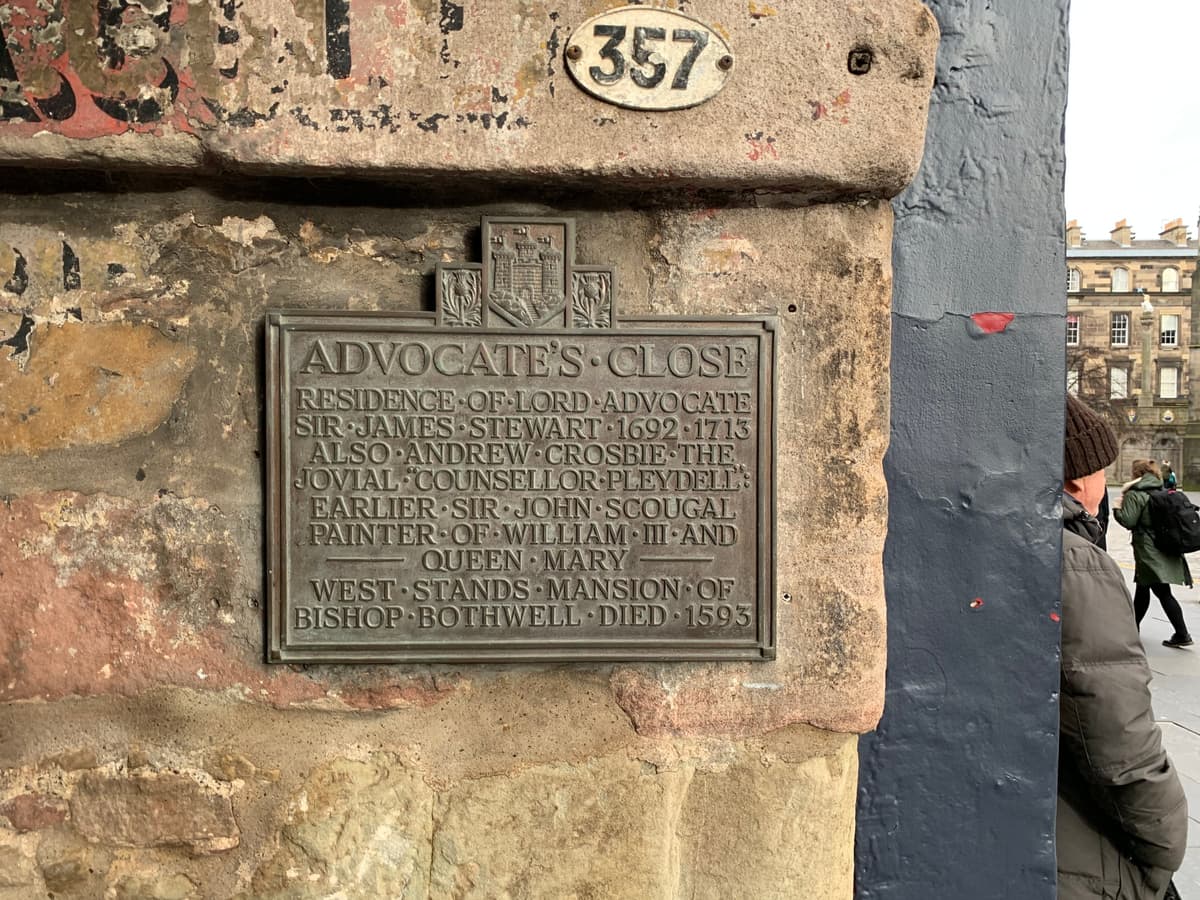
- Advocate's CloseNorth side of the High Street. To Cockburn Street, 120 steps.
- Warriston's CloseNorth side of the High Street. To Cockburn Street, 129 steps.
- Fleshmarket CloseNorth side of the High Street. To Market Street, 77 steps.
- Old Fishmarket CloseSouth side of the High Street. To the Cowgate, open to vehicles.
- Bell's WyndSouth side of the High Street. To Tron Square, 51 steps.
- Stevenlaw's CloseSouth side of the High Street. To the Cowgate.
- Chalmers CloseNorth side of the High Street. To Jeffrey Street, 20 steps.
- South Gray's CloseSouth side of the High Street. To the Cowgate, 3 steps.
- Gullan's CloseSouth side of the Canongate. To Holyrood Road.
- Old Tolbooth WyndNorth side of the Canongate. To Calton Road.
- Gentle's EntrySouth side of the Canongate. To Holyrood Road, 15 steps.
- White Horse CloseNorth side of the Canongate. To Calton Road.
Walking it: slope, cobbles and traffic
Downhill from the castle
Walked from the castle, the street runs downhill all the way. The climb from George IV Bridge up to The Hub on Castlehill takes about five minutes and is steep, with cobbled stretches.
No steps, some cobbles
The Royal Mile itself has no steps, and wheelchairs and pushchairs can use it, though parts of it are cobbled. Many of the closes off it are stairs.
Closed to traffic
Motor vehicles may not use the High Street from Parliament Square to Cockburn Street, in front of St Giles' and the Mercat Cross. Vehicles serving the premises may stand there from 06:30 to 10:30.
Road works until 30 June 2027
The High Street's setts are being renewed in phases from 21 September 2026 to 30 June 2027, with St Mary's Street, Boyd's Entry, the High Street from North Bridge to Blackfriars Street and the High Street from Blackfriars Street to Jeffrey Street closed to vehicles in turn.
Evenings in August
In August, the Lawnmarket and Johnston Terrace close to vehicles from 17:00 on most evenings.
Crowds
The street is very busy at weekends and holidays, and during the Fringe the High Street is crowded with visitors, performers and buskers. The area outside The Hub, by the castle, is busy at every time of day.
By bus
Lothian bus 35 runs along the Royal Mile on its way between Heriot-Watt and Ocean Terminal. From Waverley station, the walk up to the top of the Royal Mile is a steep hill.
Shopping on the Royal Mile
Kilts, tartan, whisky, fudge and the work of Scottish makers are all sold on the Royal Mile itself: among the shops are Tartan Weaving Mill, Geoffrey (Tailor) Kiltmakers, Gordon Nicolson Kiltmakers, The Fudge House, Tron Kirk Market and Royal Mile Whiskies. Below it, Victoria Street and the Grassmarket have more shops.
Frequently asked questions
How long is the Royal Mile?
By the shortest walk it is 1.6 km from the castle gatehouse to the gates of the Palace of Holyroodhouse. It is named after the Scots mile of 1,976 yards, which is longer than the English mile of 1,760 yards.
How long does it take to walk the Royal Mile?
23 min on foot without stops, downhill from the castle to the palace. Stops add to that: the castle alone needs at least two hours.
Why is it called the Royal Mile?
It runs from Edinburgh Castle to the Palace of Holyroodhouse, and it is about a Scots mile long. The name "Royal Mile" was coined in the late 19th century and came into wide use in the early 20th.
Can you drive on the Royal Mile?
Not all of it. The High Street from Parliament Square to Cockburn Street is closed to motor vehicles, apart from deliveries from 06:30 to 10:30. Until 30 June 2027 the lower High Street and St Mary's Street also close in phases for road works. In August the Lawnmarket closes to vehicles from 17:00 on most evenings.
What is the Heart of Midlothian?
A heart set into the paving by the West Door of St Giles' Cathedral. It marks the entrance of the Old Tolbooth, the town's tolbooth and later its prison, pulled down in 1817. Locals spat on it in contempt for the prison, and folklore says spitting on it brings luck.
Why do people rub David Hume's toe?
For luck. The big toe of the right foot of Alexander Stoddart's statue of Hume, unveiled in 1997, shines where people rub it, students above all before exams. The statue stands outside the High Court, on the Royal Mile.