Palace of Holyroodhouse
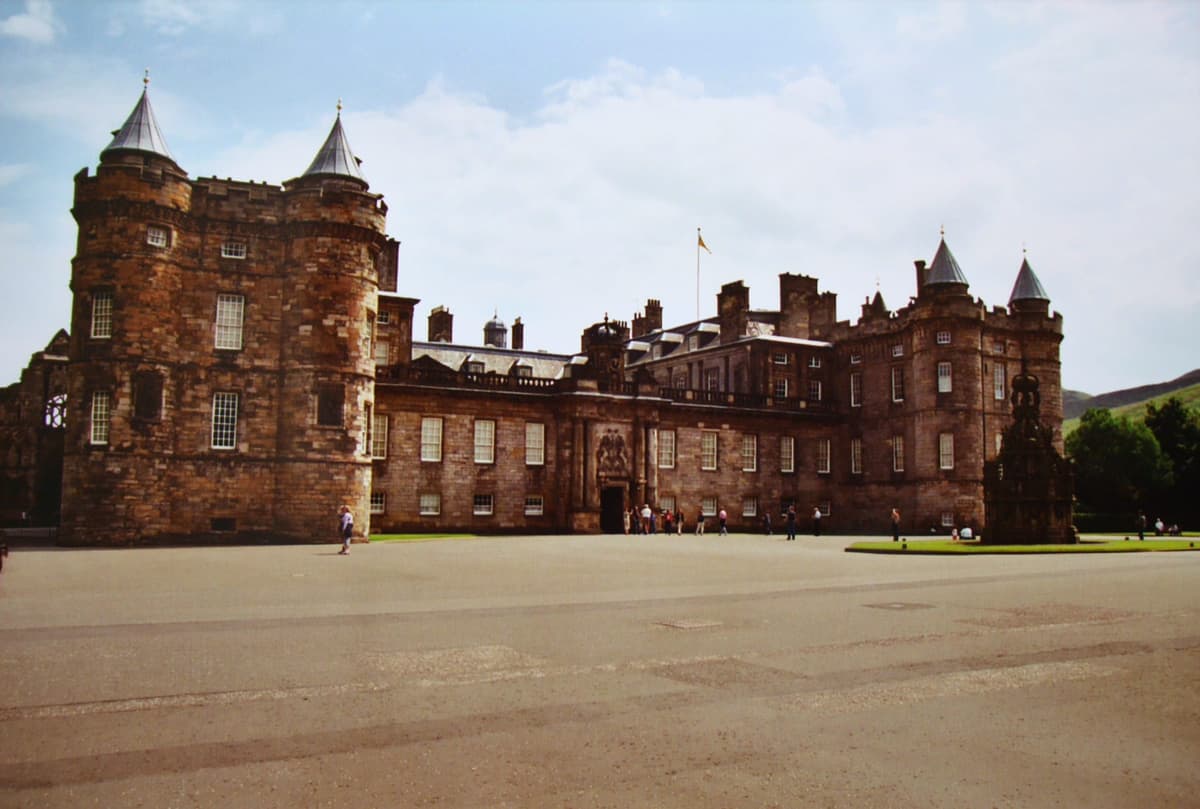
The Palace of Holyroodhouse, or Holyrood Palace, is the King's official residence in Scotland, at the foot of the Royal Mile in Edinburgh's Old Town. It opens at 09:30 and is usually closed on Tuesdays and Wednesdays, except in June, July and August. An adult ticket costs £22 in advance or £26 on the day, and it includes Holyrood Abbey.
Updated
Key facts
- Adult ticket
- £22In advance, 2026 prices; £26 on the day
- Opening hours
- 09:30 to 18:00April to October; 09:30 to 16:30 from November to March
- Last admission
- 16:3015:15 from November to March
- Usually closed
- Tuesdays and WednesdaysOpen every day in June, July and August
- Time to allow
- About one hourThe length of the free multimedia guide
- Bags
- No cloakroomNone over 45 × 20 × 30 cm
- Walk
- 15 min on footFrom the Mercat Cross
- Bus
- Lothian 35To the "Scottish Parliament" stop on the Canongate
Tickets and prices
Tickets are cheaper in advance than on the day. The admission centre is busiest from opening through the morning, so the Royal Collection Trust, which runs the palace, advises booking ahead and arriving after 11:00.
The ticket covers the State Apartments, Mary, Queen of Scots' Chambers, the abbey ruins, the gardens and the multimedia guide. A disabled visitor pays the reduced rate, and an access companion goes free.
| Ticket | 2026 in advance | 2026 on the day | 2027 in advance | 2027 on the day |
|---|---|---|---|---|
| Adult | £22 | £26 | £23 | £27 |
| Young person, 18 to 24 | £14 | £17 | £15 | £18 |
| Child, 5 to 17 | £11 | £13 | £11.50 | £13.50 |
| Disabled person | £11 | £13 | £11.50 | £13.50 |
| Access companion | Free | Free | Free | Free |
| Under 5 | Free | Free | Free | Free |
Other tickets and passes
With the King's Gallery
A combined ticket with the gallery's exhibition, The Edwardians: Age of Elegance, until 6 December 2026, takes 10 per cent off both tickets: an adult pays £29.70 in advance or £33.30 on the day, a child £14.80 or £16.60.
Exclusive Guided Tour
A private tour of the State Apartments with a guide, on a day the palace is closed to other visitors, for at most 25 people: £55 a person, with a guidebook. Day tours run on Tuesdays and Wednesdays, evening tours on Fridays and Sundays, until 2 January 2027.
1-Year Pass
A ticket can be turned into a 1-Year Pass, for free visits again for a year. Booking a return visit ahead costs £2.
£1 tickets
For visitors on Universal Credit and other named benefits.
Royal Edinburgh Ticket
The palace is one of the three sights of the Royal Edinburgh Ticket, with Edinburgh Castle and the Royal Yacht Britannia. Historic Environment Scotland's Explorer Pass does not cover the palace or the abbey. Both passes are compared with the other ways to see Edinburgh.
Opening times and closed days
| Dates | Opens | Last admission | Closes |
|---|---|---|---|
| 1 April to 31 October | 09:30 | 16:30 | 18:00 |
| 1 November to 31 March | 09:30 | 15:15 | 16:30 |
Usually closed on Tuesdays and Wednesdays; open every day in June, July and August.
The palace is a working royal palace and can close at short notice.
On the Tuesdays and Wednesdays it is closed, the Exclusive Guided Tour still takes small groups round the State Apartments.
Getting there
The palace stands at the foot of the Royal Mile, where the Canongate ends at Abbey Strand, opposite the Scottish Parliament. The Royal Mile falls all the way from the castle, from about 107 m above sea level on the Esplanade to about 37 m at the palace.
From the Mercat Cross
Down the High Street and the Canongate to the forecourt gates: 1.1 km, 15 min on foot.
From Edinburgh Castle
The whole Royal Mile, from the castle gatehouse to the palace gates: 1.6 km, 23 min on foot without stops, past the closes and sights of the Royal Mile.
From Waverley station
From the Market Street exit it is 1.1 km, 15 min on foot.
Bus 35
Lothian's 35 runs along the Royal Mile and stops at "Scottish Parliament", outside the Parliament on the Canongate, a short walk from the palace gates.
By tram
The nearest tram stop is Picardy Place, 20 min on foot from the palace.
By car
Broad Pavement car park is next to the palace, in Holyrood Park. It is paid on weekdays and free at weekends, and no car may stay in the park overnight. NCP Holyrood Road, which the Parliament calls St John's Hill, is open 24 hours. The Low Emission Zone takes in the Canongate but not Horse Wynd, Holyrood Gait and Holyrood Road.
- Palace entranceThe forecourt gates at the foot of Abbey Strand. The The King's Gallery and the Café at the Palace are at the entrance.
- Scottish Parliament, public entranceOn Horse Wynd, free to visit.
- "Scottish Parliament" bus stopBus 35, on the Canongate.
- Broad Pavement car parkIn Holyrood Park, next to the palace.
- NCP Holyrood Road2 Viewcraig Gardens, open 24 hours.
- Mercat Cross15 min on foot down the Royal Mile to the palace gates.
- Waverley, Market Street exit15 min on foot to the palace gates.
What to see, in the order of the visit
The State Apartments
The tour follows a one-way route through the State Apartments, up the Great Staircase of 27 steps. Charles II had the palace rebuilt to plans by Sir William Bruce and Robert Mylne from 1671, and the west front was finished by 1679.
The Great Gallery holds 96 of the 111 portraits of Scottish monarchs, real and legendary, that Jacob de Wet painted for Charles II from 1684 to 1686. Charles Edward Stuart, Bonnie Prince Charlie, held court at the palace for six weeks in 1745, with balls in this gallery.
- Benches in the Throne Room and the Great Gallery
Mary, Queen of Scots' Chambers
The rooms of Mary, Queen of Scots, are in James V's Tower, built from 1528 to 1532 and the oldest surviving part of the palace. She lived in them from 1561 until she was forced to abdicate in 1567, and received John Knox in the Outer Chamber.
On 9 March 1566, her secretary David Rizzio was murdered in these apartments in front of her. He was stabbed in the Outer Chamber, where an alleged bloodstain marks the place his body was left.
- A steep spiral stair of 25 steps; no wheelchair access
Holyrood Abbey
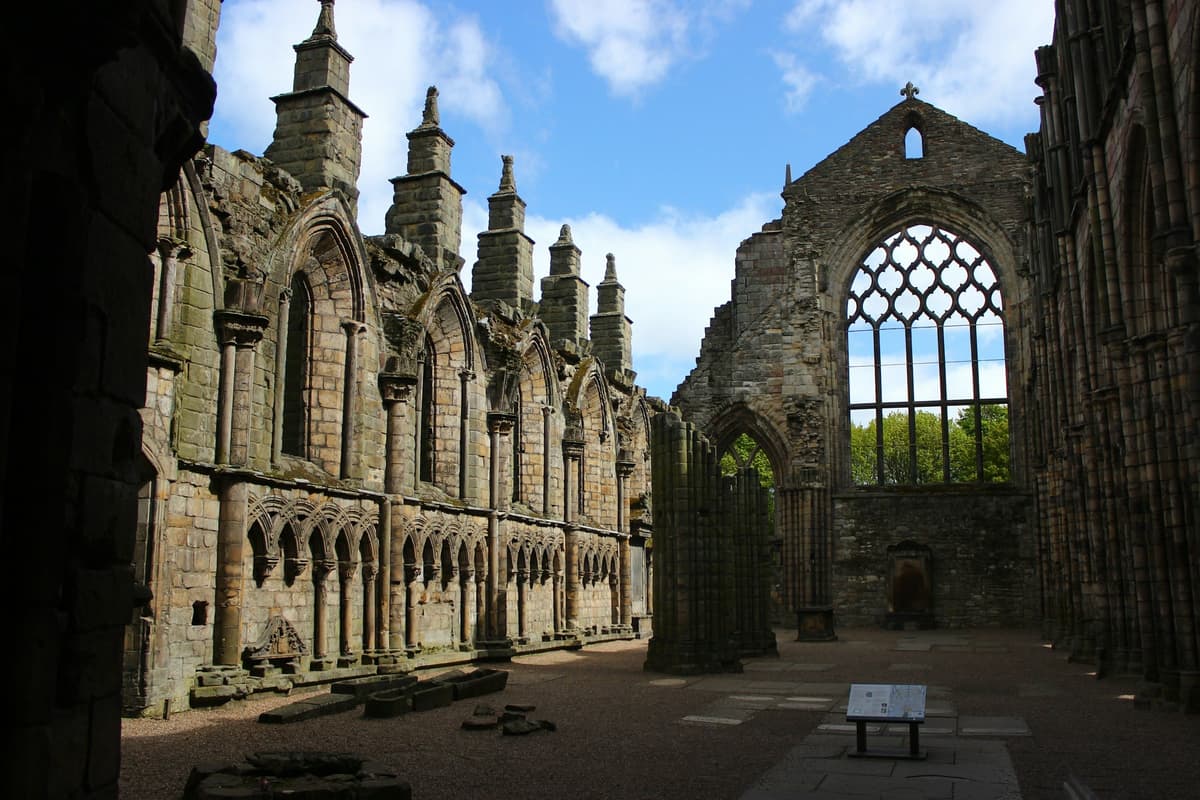
The ruined abbey stands beside the palace and is seen after the tour. David I founded it in 1128. Its surviving nave dates mainly from the 1200s, and its east processional doorway is the only part left of David I's monastery. David II, James II, James V and Lord Darnley lie in the royal vault in the south aisle.
The nave was spared at the Reformation of 1560 as the Canongate's parish church; the choir and transepts were pulled down in 1570. James VII made the nave a chapel in 1687, and within a year it was ransacked. A heavy stone roof added later fell on 2 December 1768, and the nave has stood open to the sky since.
- Gravel underfoot
The gardens
The palace garden was first used in 1503 and is still used for royal events, among them the garden parties of Holyrood Week, when members of the royal family entertain around 8,000 guests.
Bags, photos and the multimedia guide
No large bags
There is no cloakroom. Handbags and small backpacks are allowed, but bags larger than 45 × 20 × 30 cm are not, and bags are checked on arrival. Luggage storage is nearby, at Waverley station.
No photos in the State Apartments
Photography and filming are not allowed inside the State Apartments. Photos for your own use are welcome outside.
No food or drink inside
Only bottled water. A drinking fountain and a tap to refill bottles are in the Mews Courtyard, by the Café at the Palace.
No drones
Drones are not allowed anywhere at the palace.
The free multimedia guide is in English and nine other languages, Gaelic among them, and in British Sign Language with subtitles. A family tour in English is aimed at children of 7 to 11.
The tour is indoors, with some small rooms, and goes on into the garden. Pushchairs can go in except at busy times, when there is a place to leave them inside the entrance. Toilets and baby-care facilities are in the Mews Courtyard.
The Café at the Palace, with accessible toilets, can be visited without a ticket.
Wheelchairs, steps and the lift
The palace is largely accessible. Manual wheelchairs and rollators can be borrowed free, first come, first served. The Great Staircase has 27 steps: for step-free access, ask a warden. The lift is 130 cm wide and 125 cm deep, with a door 89 cm wide, and a mobility scooter can go in if it fits the lift.
Mary, Queen of Scots' Chambers, up their spiral stair, have no wheelchair access. The floor of the abbey is gravel. There are few benches.
An audio-descriptive guide is available for blind and partially sighted visitors. Registered assistance dogs are welcome; other dogs are not.
Accessible parking spaces are on Horse Wynd, just outside the palace, first come, first served.
The King's Gallery
The King's Gallery, at the palace entrance, shows changing exhibitions from the Royal Collection on its first floor, up a staircase or by lift. It was built from 1999 to 2002 inside the shell of a 19th-century church and school, opened in 2002 and took its present name in 2024.
It has its own ticket. Bought together with the palace, both tickets are 10 per cent cheaper.
The gallery is closed from 7 December 2026 to 22 April 2027, between exhibitions.
- The Edwardians: Age of Elegance
- £11
- Adult; until 6 December 2026
- Portrait Miniatures: 500 Years of Love and Loyalty
- £12
- Adult; 23 April to 30 August 2027; young person £8, child £6
- Opening hours
- 09:30 to 18:00
- April to October, last admission 17:00; 09:30 to 16:30 from November to March, last admission 15:30
The palace's story in brief
Legend has it that David I was thrown from his horse while hunting below Salisbury Crags and attacked by a stag, and saved by a holy rood, a cross, that appeared in his hands; in thanks he endowed a monastery of the Holy Rood. What is known is that the abbey was founded on his orders in 1128.
The monarch spends a week at the palace each summer, Holyrood Week, which usually runs from the end of June to the beginning of July. The apartments in James V's Tower have been open to the public since 1854. The Old Town's history runs up the ridge from here.
1128
David I founds Holyrood Abbey.
1501
James IV builds a palace beside the abbey.
August 1503
James IV marries Margaret Tudor in the abbey.
1688
The abbey nave, a royal chapel since the year before, is ransacked.
1854
The historic apartments open to the public.
2002
Queen Elizabeth II opens the gallery now called the King's Gallery.
Across the road: the Scottish Parliament
The Scottish Parliament stands opposite the palace on Horse Wynd, 16 min on foot from the Mercat Cross. The building, designed by Enric Miralles, who died before it was finished, opened in 2004 and won the Stirling Prize in 2005.
Entry is free and needs no booking. Everyone goes through security: come 20 minutes before a booked event, or one hour before First Minister's Questions. Inside are an exhibition, a café and a shop. Photos, videos and recordings are not allowed during meetings. The hours, tours and open parts of the building can change at short notice.
Scottish Water's first free Top Up Tap for refilling bottles was put in at the Parliament in October 2018.
| Days | Open | Last entry |
|---|---|---|
| Tuesday, Wednesday and Thursday | 09:00 to 18:30 | 18:00 |
| Monday, Friday and Saturday | 10:00 to 17:00 | 16:30 |
Monday, Friday and Saturday hours apply on public holidays too.
Guided tours
Free tours of 45 minutes run from Monday to Saturday; they are popular, so book ahead. The route is accessible by wheelchair. Free 10-minute talks run through the day.
First Minister's Questions
On Tuesdays and Thursdays, for 30 minutes: free, but book ahead.
Debates
Meetings in the Debating Chamber, from Tuesday to Thursday, are open to the public. Walk in on the day or book ahead; tickets are free.
Recess
No debates and no First Minister's Questions in recess: 19 December 2026 to 3 January 2027, 13 to 21 February 2027, 3 to 18 April 2027, 26 June to 29 August 2027, 9 to 24 October 2027 and 20 December 2027 to 2 January 2028.
Next door: Holyrood Park and Dynamic Earth
Holyrood Park lies next to the palace, free and open at all hours. The walking routes up Arthur's Seat start by the palace.
Dynamic Earth, on Holyrood Road, 16 min on foot from the Mercat Cross, sells an annual pass rather than a day ticket. An average visit there takes two to three hours.
- Palace forecourt gatesThe way in to the palace, at the foot of Abbey Strand.
- Holyrood Park entranceWhere Horse Wynd meets Queen's Drive, by the palace.
- Dynamic EarthOn Holyrood Road, 16 min on foot from the Mercat Cross.
Frequently asked questions
Can you visit the Palace of Holyroodhouse?
Yes. The palace is the King's official residence in Scotland and opens to visitors all year with a paid ticket. It is usually closed on Tuesdays and Wednesdays, except in June, July and August, and it can close at short notice. Holyrood Abbey and the gardens are seen on the same ticket.
How long do you need at the Palace of Holyroodhouse?
The free multimedia guide takes about one hour through the State Apartments and Mary, Queen of Scots' Chambers. The abbey and the gardens come after it, and the King's Gallery next door has its own ticket.
Is Holyrood Abbey included in the palace ticket?
Yes. The abbey ruins are reached only through the palace, on the palace ticket. Historic Scotland members and Explorer Pass holders pay too: Historic Environment Scotland gives its members 20 per cent off.
Can you take photos inside the Palace of Holyroodhouse?
Not inside the State Apartments, where photography and filming are not allowed. Photos for your own use are welcome in the outside areas of the palace. Drones are not allowed anywhere.
Can you go inside the Scottish Parliament?
Yes, for free and without booking, whenever the building is open: 09:00 to 18:30 from Tuesday to Thursday, and 10:00 to 17:00 on Mondays, Fridays and Saturdays. Guided tours are free too, and best booked ahead.
Why is Holyroodhouse famous?
It is the King's official residence in Scotland and has been a royal home for over 500 years. Mary, Queen of Scots, lived here from 1561 to 1567, and her secretary David Rizzio was murdered in her rooms in 1566.