Edinburgh Castle
Edinburgh Castle stands on Castle Rock at the top of the Royal Mile, in Edinburgh's Old Town. Once tickets sell out online, none are sold at the castle. An adult pays £23.50 online or £26 at the castle. It opens at 09:30, with last entry at 17:00 in summer and 16:00 in winter; allow at least two hours.
Updated
Key facts
- Adult ticket
- £23.50Online; £26 at the castle. Under 7 free, but booked
- Booking
- Timed tickets onlineNone on sale at the castle once they sell out online
- Opening hours
- 09:30 to 18:00April to September; 09:30 to 17:00 from October to March
- Last entry
- 17:0016:00 from October to March; closed 25 and 26 December
- Time to allow
- At least two hours
- Bags
- Under 30 litresNo suitcases, and no luggage storage
- Walk up
- 8 min on footFrom the Mercat Cross; 11 min on foot from Waverley, uphill
- The way up inside
- Steep and cobbledA mobility vehicle runs to Crown Square on request
Tickets and prices
A standard ticket is for a set entry time and costs less online than at the castle. Tickets often sell out far in advance, above all in summer, so book ahead.
Children under 7 go free but must be added to the booking. Children under 16 must come with an adult.
| Ticket | Online | At the castle |
|---|---|---|
| Adult, 16 to 64 | £23.50 | £26 |
| Concession, 65 and over or unemployed | £19 | £21 |
| Child, 7 to 15 | £11.50 | £13 |
| Under 7 | Free, booked | Free |
| Flexi ticket, adult | £38 | Online only |
| Flexi ticket, concession | £30.50 | Online only |
| Flexi ticket, child | £22.50 | Online only |
Prices shown in November 2026. The concession price does not apply to students. A Flexi ticket gives one entry on any day within seven days of the date you choose, with no timeslot to book.
Who goes free or pays less
Historic Scotland members and Explorer Pass holders
Free. Book online to be sure of a place. Historic Environment Scotland's Explorer Pass covers the castle and its other sites for 14 days in a row, one visit each.
English Heritage, Cadw and Manx members
Half price in the first year of membership; free for renewal and life members.
Carers
Free for carers with a disabled visitor, up to two per booking.
British Armed Forces
Free for serving members: book the "HM Forces" ticket and bring a MOD 90 card.
Young Scot and National Entitlement Card holders
Scots aged 7 to 25 with either card pay £1.
Guided tours and the audio guide
Official Guided Tour
A guided tour ticket includes entry to the castle and a 30-minute tour in English. The tour costs £6.50 per visitor and must be booked ahead. There are twelve tours a day from 09:45 to 15:45 from April to September, and five from 10:15 to 15:15 from October to March.
Audio guide
The audio guide costs £4, on a hired device or on your own phone, in English and eleven other languages. Historic Scotland members and Explorer Pass holders get 20 per cent off, and it is free to blind and partially sighted visitors.
Opening times and last entry
| Dates | Opens | Last entry | Closes |
|---|---|---|---|
| 1 April to 30 September | 09:30 | 17:00 | 18:00 |
| 1 October to 31 March | 09:30 | 16:00 | 17:00 |
| 24 December | 09:30 | 15:00 | 16:00 |
| 25 and 26 December | Closed | Closed | Closed |
| 1 January | 11:00 | 16:00 | 17:00 |
Last entry is an hour before closing. On the other days of Christmas and New Year the winter hours apply.
Early morning is the quietest time to visit. August, the month of the summer festivals, is the busiest of the year.
The National War Museum and the regimental museums inside the castle keep shorter hours of their own.
Getting there and the way up
The castle stands at the top of the Royal Mile, at the west end of the Esplanade. Every way up is uphill, and no bus or tram reaches the gate.
From the Royal Mile
From the Mercat Cross by St Giles', the gatehouse is 540 m up the High Street, the Lawnmarket and Castlehill: 8 min on foot.
From Waverley station
From the station's Market Street exit it is 810 m and 11 min on foot, uphill all the way.
From the Grassmarket
The Castle Wynd steps climb 158 steps on three stairs, Castle Wynd South, the Patrick Geddes Steps and Castle Wynd North, from the Grassmarket to Castlehill, 300 m from the gatehouse.
By bus
Get off on the Mound or George IV Bridge. Lothian buses 9, 23 and 27 stop on George IV Bridge, a short walk from the castle by Castlehill.
By tram
Princes Street is the closest tram stop, opposite the Mound. Walk up the Mound and Bank Street to the Lawnmarket, then along Castlehill.
By car
The castle has no public parking. The nearest car park is NCP Castle Terrace, with 750 spaces, open 24 hours. Driving there takes you into the Low Emission Zone.
- Castle gatehouseThe way in, at the west end of the Esplanade.
- Ticket officeOn the Esplanade.
- Mercat Cross8 min on foot up the Royal Mile to the gatehouse.
- Waverley, Market Street exit11 min on foot to the gatehouse, uphill all the way.
- Castle Wynd steps158 steps from the Grassmarket up to Castlehill.
- George IV BridgeLothian buses 9, 23 and 27 stop here.
- Princes Street tram stopOpposite the Mound.
- NCP Castle TerraceThe nearest car park.
Bags, dogs and access
No large bags
Suitcases and rucksacks of 30 litres or more are not allowed in. The castle stores no luggage, prams or pushchairs, and bags may be searched at the entrance.
No dogs
Only assistance dogs are allowed in.
The Esplanade is smooth tarmac, 110 m long, rising at 5 degrees. Inside the gate, the route to Crown Square climbs about 350 m on curved cobbles, 15 degrees at the steepest and 5 on average. The steepest stretch is through Foog's Gate, where short flights of steps lead into the Prisons of War.
A mobility vehicle runs to Crown Square on request: ask the staff at the entrance. It takes three passengers and one wheelchair user, and does not run from 12:15 to 13:15, while the One O'Clock Gun is fired. Manual wheelchairs can be borrowed, first come, first served.
Crown Square is level and paved, and the Great Hall and the Scottish National War Memorial have ramps. The Royal Palace has a short flight of stone steps. The way out is down 70 stone steps with a handrail; staff can guide you back down another way.
Adapted toilets are on the left just inside the entrance, and in Crown Square between the Great Hall and the Crown Gift Shop. Sensory backpacks can be borrowed from the ticket office. Tours in British Sign Language are arranged through interpretation@hes.scot.
A few parking spaces on the Esplanade are kept for ticket holders with access needs: ask on arrival, or book through ecparking@hes.scot. From May to October, while the Tattoo stands are up, they may be limited.
Without a ticket
The Esplanade
Tickets are scanned before you enter the castle, so the Esplanade in front of it, with the ticket office, is where a visit without a ticket ends. The public toilets at 356 Castlehill, by the Esplanade, open 10:00 to 20:00 in winter.
The Scottish National War Memorial
The memorial can be visited on its own, free, by writing ahead to ticketing@hes.scot. Such a visit gives no access to the rest of the castle, and it is not possible from 12:30 to 13:30 or during ceremonial events such as gun salutes.
The time ball on Calton Hill
On Calton Hill, the time ball on the Nelson Monument, added in 1853, is lowered as the One O'Clock Gun fires.
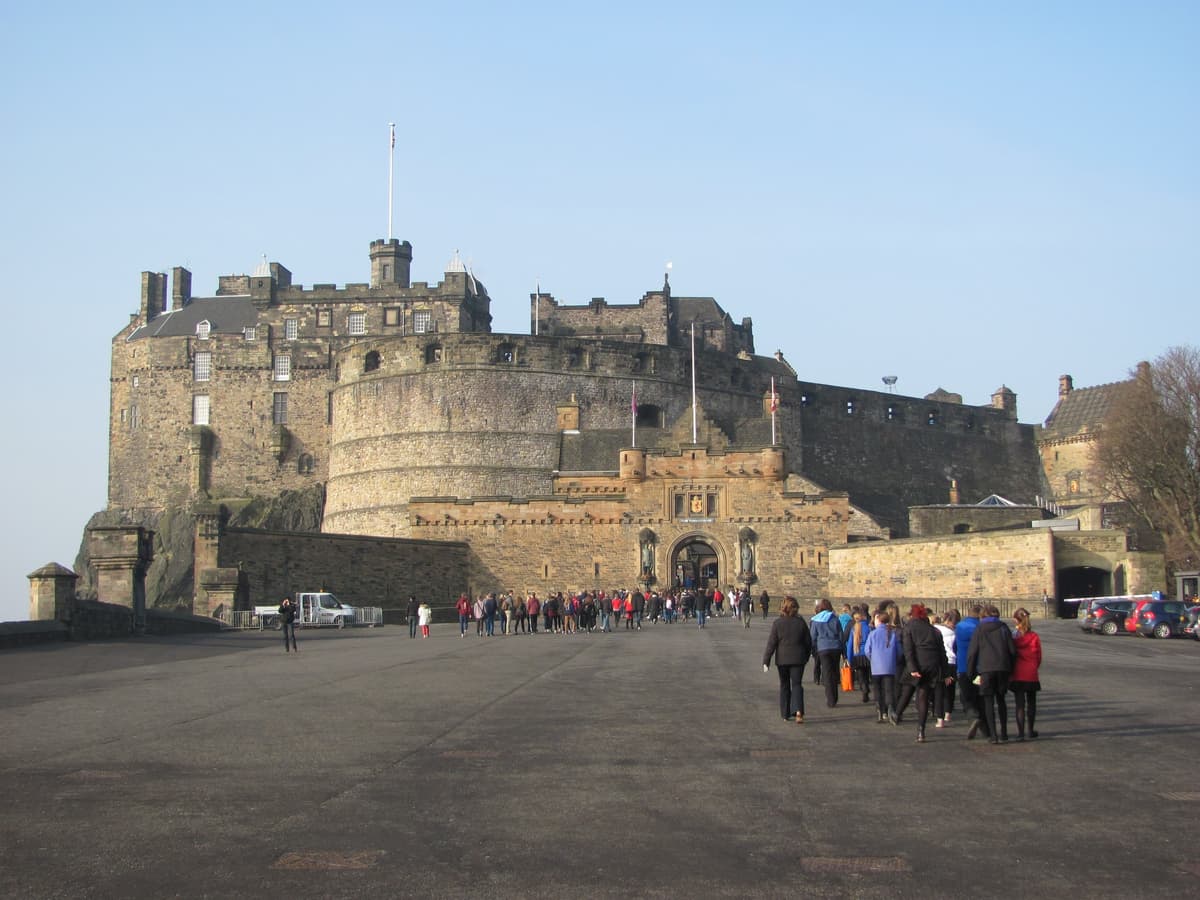
The Esplanade and the Tattoo stands
The Esplanade is the open ground in front of the gatehouse, where the Tattoo is staged every August, in 2027 from 6 to 28 August. Its stands are up from May to October.
While the stands are up there are no bike racks. From November to April, the racks are on the left as you come onto the Esplanade, behind the ticket box.
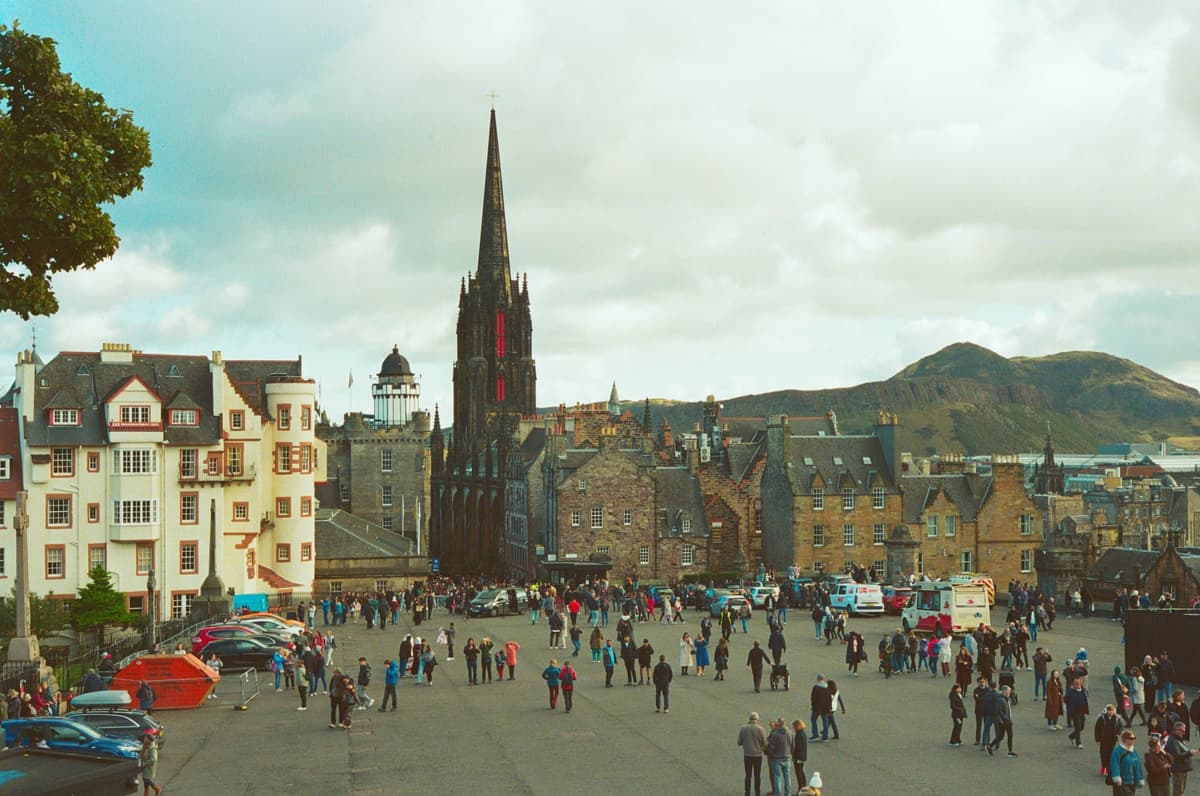
What to see inside, in the order you meet it
The gatehouse
You cross the drawbridge into the castle through the gatehouse, built in the 1880s. Its statues of William Wallace and Robert the Bruce were added in 1929. The moat below never held water.
The One O'Clock Gun
Through the Portcullis Gate, on the right at the far end of the Argyle Battery, the gun stands on the Mills Mount Battery by the Redcoat Café. It fires at 13:00 every day except Sundays, Good Friday and Christmas Day. The shot is loud and sudden.
The gun has been fired since 1861, and ships in the Firth of Forth once set their clocks by it. Since 2001 it has been a 105mm field gun.
- Redcoat Café: daily, 09:30 to 16:00
The National War Museum
The museum in Hospital Square opened in 1933 and is run by National Museums Scotland. Part of it is closed for building repairs.
- 09:45 to 17:45 from April to September, last entry 17:30
- 09:45 to 16:45 from October to March, last entry 16:30
- Closed 25 and 26 December
The Prisons of War
The vaults under Crown Square held many hundreds of prisoners of war between 1757 and 1814. The first were French privateers caught in 1758. In 1811, 49 prisoners escaped through a hole in the defences that can still be seen.
- Reached by short flights of steps with handrails
St Margaret's Chapel
Through Foog's Gate on the left, beyond the Whisky and Finest Food Shop, stands the oldest surviving building on Castle Rock. Its chancel arch dates from about 1110 to 1120. Historic Environment Scotland says King David I built the chapel around 1130 and named it for his mother, Queen Margaret, who was made a saint in 1250. Its origins were forgotten until the antiquary Sir Daniel Wilson rediscovered them in 1845.
Mons Meg
The siege gun outside the chapel was made in 1449 for Philip the Good, Duke of Burgundy, and is named after the Belgian town where she was made. She was given to King James II in 1457. She weighs six tonnes and could fire a 150 kg gunstone up to 3.2 km.
When Mary, Queen of Scots, married in 1558, Mons Meg fired a gunstone over the city that landed in what is now the Royal Botanic Garden. Her barrel burst in 1681, and after 75 years in England she came back to the castle in 1829.
The Great Hall
The Great Hall on Crown Square was completed in 1511 for King James IV. The giant beams of its wooden roof rest on stones carved with heads and symbols such as the thistle. After Oliver Cromwell's army took the castle in 1650, the hall became a barracks.
The Royal Palace and the Honours of Scotland
In the Royal Palace, on the east side of Crown Square, Mary, Queen of Scots, gave birth to James VI in 1566. The gilded initials MAH over the door stand for her and her second husband, Henry Stewart, Lord Darnley. The room where James was born can be seen from behind a cordon. Charles I was the last monarch to stay here, on 17 June 1633, the night before his Scottish coronation.
The Honours of Scotland are on show in the Crown Room, on the palace's first floor. The crown was made for James V, who first wore it at the coronation of Mary of Guise in 1540, and Mary, Queen of Scots, was the first to be crowned with the crown and sceptre together, in 1543. The Honours were hidden from Cromwell from 1651 to 1660, locked away in 1707 and found again by Sir Walter Scott in 1818. In the Second World War the crown was hidden in a medieval latrine in David's Tower.
- A short flight of stone steps, with a handrail, at the entrance and the exit
The Scottish National War Memorial
On the north side of Crown Square, the former North Barracks was altered to make the memorial, which opened in 1927. Photography is not allowed inside, and visitors keep silent.
The regimental museums
The Royal Scots Dragoon Guards Museum and the Royal Scots/Royal Regiment of Scotland Museum keep their own hours, shorter than the castle's, and close for longer over Christmas and New Year.
- Royal Scots Dragoon Guards: 09:30 to 17:15 from April to September, 09:30 to 16:15 from October to March; closed 24 to 26 December and 1 and 2 January
- Royal Scots/Royal Regiment of Scotland: 09:30 to 15:45 on weekdays and to 16:30 at weekends in winter; closed 21 December to 5 January
- Redcoat Café
- 09:30 to 16:00
- Daily, by the One O'Clock Gun
- The Tea Rooms
- 10:30 to 16:00
- Daily
- Orientation map
- Free
- Given out on arrival
Where the Stone of Destiny is now
The Stone of Destiny is no longer at Edinburgh Castle. It was on show there from 1996, and it is now at Perth Museum, where it arrived shortly before the museum opened in March 2024.
The First Minister announced the move on 23 December 2020, and a farewell ceremony at the castle marked its departure in March 2024. The stone can still go back to Westminster Abbey for future coronations.
- Now at
- Perth Museum
- St John's Place, Perth PH1 5SZ
- Entry
- Free
- Timeslots are booked at the museum's front desk
- At the castle
- 1996 to 2024
The castle's story in brief
Castle Rock is a volcanic plug of dolerite, formed about 340 million years ago; its summit is 130 m above sea level. Ice moving from the west parted around the rock and dug the valleys on either side, Princes Street Gardens to the north and the Grassmarket and the Cowgate to the south, and left the ridge of the Royal Mile behind it.
Historic Environment Scotland, which runs the castle, calls it "the most besieged place in Britain". Parts of it are still in military use, and some regimental mascots are buried in its Dog Cemetery. The rest of the Old Town's history runs down the ridge from here.
Iron Age
People build a hill fort on the rock.
1093
Queen Margaret, later made a saint, dies at the castle.
1314
The Scots retake the castle from the English in a night raid led by Thomas Randolph, nephew of Robert the Bruce.
1571 to 1573
The Lang Siege brings down David's Tower, begun by King David II in 1367.
1639
Covenanter forces under Alexander Leslie take the castle in 30 minutes.
1650
Oliver Cromwell's army captures the castle.
1715
A Jacobite force fails to take the castle.
1747
Ordnance Survey begins in the military surveyor William Roy's drawing office at the castle.
1995
The castle becomes part of the World Heritage Site "Old and New Towns of Edinburgh".
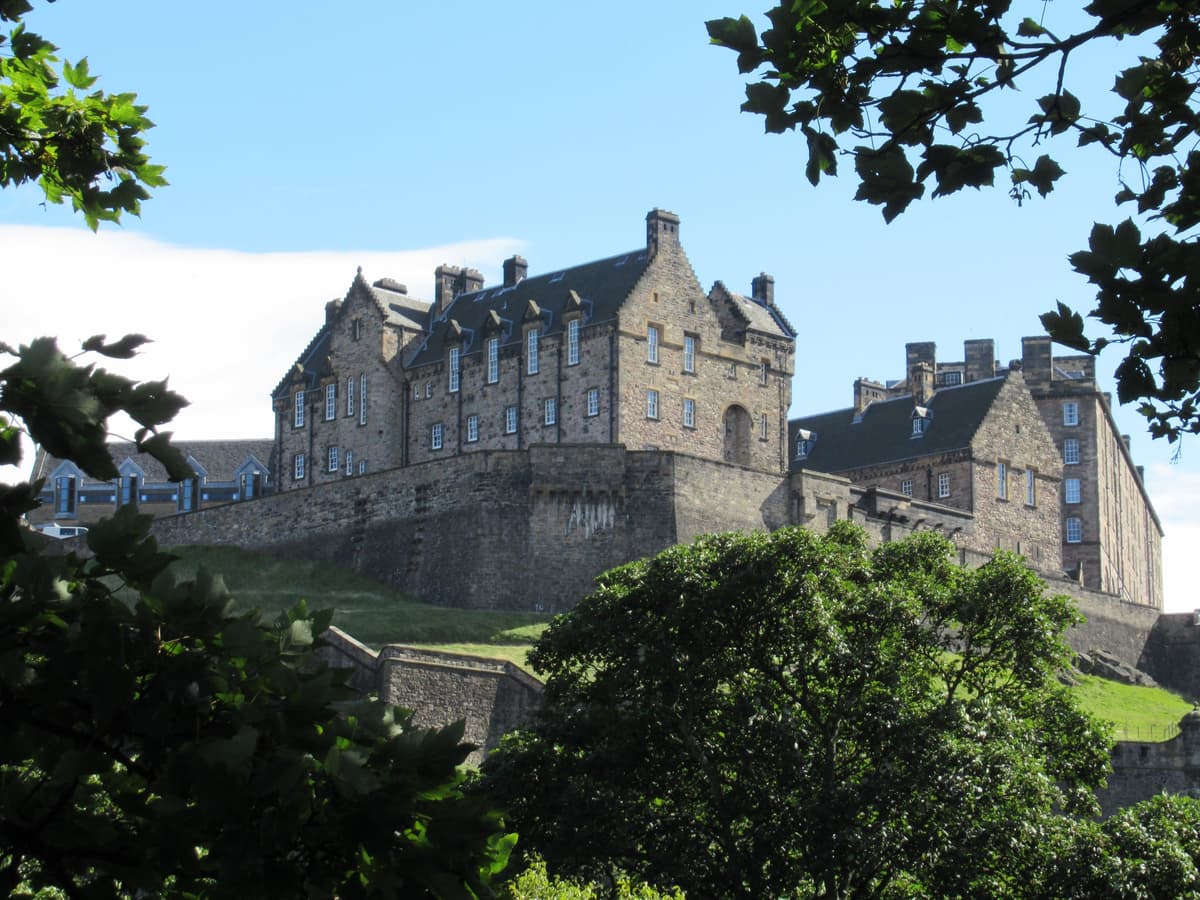
Below the castle: Princes Street Gardens and the Ross Fountain
Princes Street Gardens fill the valley between the Old and New Towns, with the castle on its rock above the western end. James Skene laid out West Princes Street Gardens for the owners of Princes Street around 1820. Dogs must be kept on leads.
The Ross Fountain stands in West Princes Street Gardens, 14 min on foot from the Mercat Cross. Antoine Durenne cast it to a design by Jean-Baptiste Klagmann; it was shown at the International Exhibition in London in 1862, bought by the gunsmith Daniel Ross and put up in the gardens in 1872. It is a Category A listed building, and after its restoration it was switched on again on 8 July 2018.
The floral clock was first planted in 1903. Each year it takes about 30,000 plants, in a new design that marks an anniversary.
| Dates | Gardens close |
|---|---|
| 1 January to 29 March | 18:00 |
| 30 March to 26 April | 19:00 |
| 27 April to 31 May | 20:00 |
| 1 June to 30 August | 22:00 |
| 31 August to 27 September | 20:00 |
| 28 September to 25 October | 19:00 |
| 26 October to 31 December | 18:00 |
The gardens open at 07:00. The gates start closing about an hour before the closing time.
- West Princes Street GardensThe gardens under the castle rock.
- Ross FountainPut up in 1872; 14 min on foot from the Mercat Cross.
- Floral clockFirst planted in 1903.
Frequently asked questions
Can you walk around Edinburgh Castle without a ticket?
Not inside: tickets are scanned before you enter the castle, so without one a visit ends on the Esplanade. The Scottish National War Memorial can be visited on its own, free, if you write ahead to ticketing@hes.scot; that visit gives no access to the rest of the castle.
How many hours do you need at Edinburgh Castle?
Historic Environment Scotland advises at least two hours for the main sights. Its own suggested routes run from one hour, for the Portcullis Gate, the Lang Stairs and St Margaret's Chapel, to three hours for a family day out.
What happens at 1 o'clock at Edinburgh Castle?
The One O'Clock Gun is fired from the Mills Mount Battery at 13:00, every day except Sundays, Good Friday and Christmas Day. It has been fired since 1861; ships in the Firth of Forth once set their clocks by it.
Was Harry Potter filmed at Edinburgh Castle?
VisitScotland's Harry Potter itinerary names Glenfinnan and Glen Etive among the films' Scottish locations. Edinburgh's link is to the books: J.K. Rowling wrote in the Old Town's cafés.
Is it better to visit Edinburgh Castle in the morning or the afternoon?
The early morning, from the 09:30 opening, is the quietest time. August, the month of the summer festivals, is the busiest.
Is there parking at Edinburgh Castle?
No. The castle has no public parking; the nearest car park is NCP Castle Terrace, open 24 hours. A few spaces on the Esplanade are kept for ticket holders with access needs, on arrival or booked through ecparking@hes.scot.