Greyfriars Bobby and Greyfriars Kirkyard
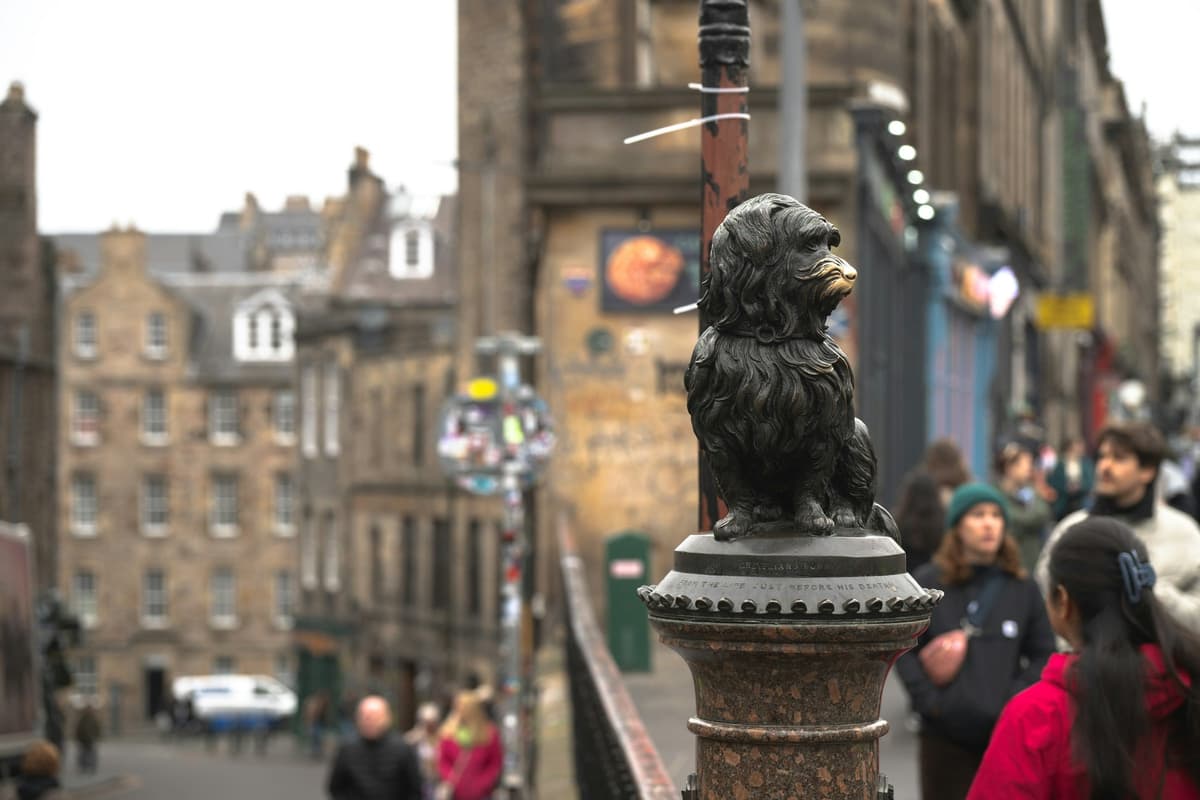
Greyfriars Bobby's statue stands at the top of Candlemaker Row, beside the gate of Greyfriars Kirkyard on the southern edge of Edinburgh's Old Town, 8 min on foot from the Mercat Cross. The kirkyard is open at all hours, and Bobby's headstone is just inside the gate. Greyfriars Kirk and its museum open Monday to Saturday from April to October.
Updated
Key facts
- Where
- Candlemaker RowAt the south end of George IV Bridge
- Kirkyard
- Open at all hoursThrough the gate on Candlemaker Row
- Kirk and museum
- April to OctoberMonday to Saturday
- Walk
- 8 min on footFrom the Mercat Cross to the statue
- The statue
- Do not touchRubbing the nose is damaging it
- Covenanters' Prison
- LockedOpened for tours and by arrangement
- Toilets
- None in the kirkyardThe kirk has accessible toilets when it is open
Getting there and getting in
The kirkyard's main gate is at the top of Candlemaker Row, where it meets George IV Bridge, with the statue of Bobby on the corner outside. It stands open day and night, and the council, which has owned the kirkyard since 1562, looks after it.
The ground inside slopes. Old stone setts at the gate give way to smoother paths that circle the kirk and run round the edges; there are no formal paths inside the burial sections. The kirkyard has no toilets and no car park.
From the Royal Mile
From the Mercat Cross it is 530 m to the statue: 8 min on foot.
From the Grassmarket
From the Covenanters' Memorial in the Grassmarket it is 260 m to the statue by Candlemaker Row, which runs uphill for 190 m from the Cowgate to George IV Bridge.
From Waverley station
The kirk puts it at a 10-minute walk from Edinburgh Waverley, uphill.
By bus
Buses 2, 9, 23, 27, 35 and 45 stop close by.
Greyfriars Bobby's story, and what historians doubt
Bobby was a terrier, a Skye terrier or a Dandie Dinmont, who lived from 1855 to 1872. The story goes that after his master, John Gray, died in 1858, Bobby kept a vigil by the grave in Greyfriars Kirkyard for 14 years, until his own death.
During his vigil the Traill family, who ran Traill's Coffee House at 5 & 6 Greyfriars Place, fed him from his own dish. In 1867 he was picked up without a licence, and the Lord Provost, Sir William Chambers, paid for his licence and a collar. The collar and the dish are now in the Museum of Edinburgh. Bobby died on 14 January 1872 and was buried just inside the kirkyard gate, not far from Gray's grave.
The story has its doubters. The historian Jan Bondeson argued in a book of 2011 that dogs in graveyards were common strays, and that the first Bobby may have been replaced by a younger dog in 1867, which would explain his long life. John Traill said Gray came to his coffee house when the One O'Clock Gun fired, but Traill only took it over four years after Gray died.
Eleanor Atkinson's novel of 1912 embellished the story, and Walt Disney's film of 1961, "Greyfriars Bobby: The True Story of a Dog", was based on it. The kirk's museum shows an oil painting of Bobby from 1867.
What to see in the kirkyard
- Greyfriars Bobby statueOn the corner of Candlemaker Row and George IV Bridge.
- Kirkyard gateThe main gate, at the top of Candlemaker Row.
- Bobby's headstoneJust inside the gate.
- Greyfriars KirkThe kirk and its museum, open April to October.
- Flodden WallThe old town wall along the kirkyard.
- Sir George Mackenzie's mausoleumThe domed tomb of 1691.
- Covenanters' PrisonBehind locked iron gates, at the southern end.
The statue of Bobby
William Brodie's life-size bronze of Bobby, on a red granite plinth with basins, went up in 1873, a year after his death. It was paid for by Baroness Burdett-Coutts and unveiled on 15 November 1873. The remains of the drinking fountain it once was can be seen underneath. Its inscription reads: "A tribute to the affectionate fidelity of Greyfriars Bobby. In 1858 this faithful dog followed the remains of his master to Greyfriars churchyard and lingered near the spot until his death in 1872. With permission erected by Baroness Burdett Coutts."
A habit of rubbing Bobby's nose for luck has grown up in recent years, and it is affecting the statue badly. Culture Edinburgh, the council's museums service, asks visitors and guides not to touch it.
- Greyfriars Bobby's Bar is beside it, at 30-34 Candlemaker Row
The kirkyard gate
The main gateway at the top of Candlemaker Row, with its stone setts and a stone bothy, is open at all hours. City of the Dead Tours has its office in the Greyfriars Funeral Bothy, just inside the entrance.
Bobby's headstone and John Gray's grave
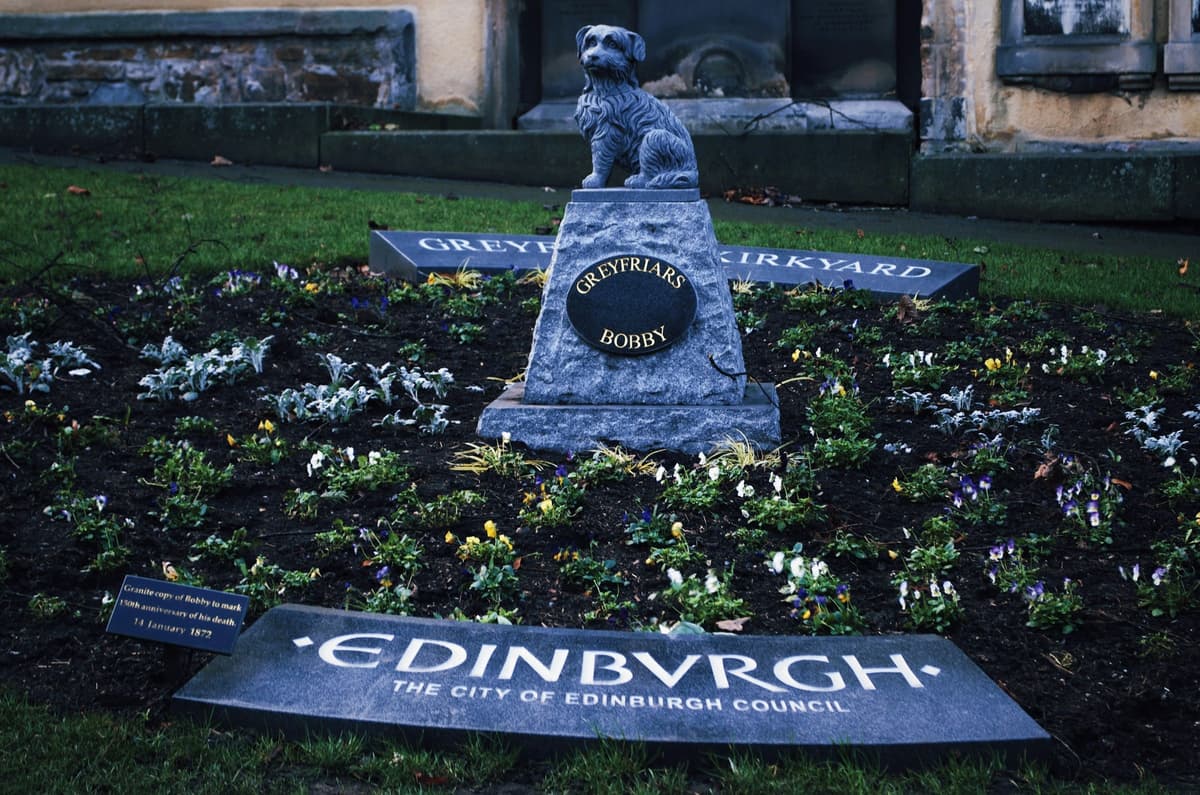
Bobby's headstone, just inside the gate, marks his reputed burial place. The Dog Aid Society of Scotland put it up, and the Duke of Gloucester unveiled it on 13 May 1981. John Gray's grave is on the eastern path, about 30 m north of the entrance, under a stone put up by American dog lovers.
Greyfriars Kirk
The kirk, opened on Christmas Day 1620, stands inside the kirkyard, and its museum shows an original copy of the National Covenant.
The Flodden Wall and the Telfer Wall
The Flodden Wall, the town wall built in the early 16th century after the defeat at Flodden, divides the main kirkyard from the West Yard, and several of the most elaborate burial vaults of the 17th century are built into it. The Telfer Wall, named after its mason, John Taillefer, was built from 1628 to 1636 round the ground to the south and west.
Sir George Mackenzie's mausoleum
The domed round temple on the south wall was designed by James Smith in 1691, after Bramante's Tempietto. Nobody can get into it.
The Covenanters' Prison
The long, narrow section at the southern end is entered through locked iron gates. Covenanters taken prisoner after their defeat at Bothwell Bridge in 1679 were held in its eastern part.
The Martyrs' Monument
The monument commemorates the Covenanters executed in Edinburgh.
The mortsafes
Two low iron cages over graves are mortsafes, put there against the body snatchers who supplied bodies for dissection.
Who is buried here
Burials began here in the late 16th century, after Mary, Queen of Scots, gave the friars' old grounds to the town council for a burial ground. Among those buried are James Douglas, Regent Morton, George Buchanan, Allan Ramsay, Joseph Black, William Adam and Duncan Ban Macintyre.
Harry Potter fans look for the graves of Thomas Riddell and William McGonagall. J.K. Rowling said in 2022 that her characters' names did not come from the kirkyard, which she knew of only through one of her children. She did write in Edinburgh, at Nicolson's and The Elephant House.
To walk the kirkyard with a guide by day, Witchery Tours' Greyfriars Cemetery Tour is an afternoon walk through its history, with no ghost stories. It starts outside the company's shop, 84 West Bow, on Victoria Street.
How to see the Covenanters' Prison
The council locked the Covenanters' Prison around 1990, to stop vandalism, and keeps its gates locked at times to protect the graves. There are three ways in.
Ask the council
Write to the council's bereavement team at bereavement@edinburgh.gov.uk to arrange a visit.
Join an open day
The Friends of Greyfriars Kirkyard hold free tours and open days.
Go on a night tour
City of the Dead Tours' Haunted Graveyard Tour and Double Dead Tour go into the prison in the evening. Both leave from the Tree of the Dead by the roadside wall of St Giles' Cathedral, near the Mercat Cross, and neither takes under-12s.
Greyfriars Kirk and the National Covenant
Greyfriars Kirk stands on the site of a Franciscan friary and takes its name from the robes the friars wore. It opened on 25 December 1620, and the kirk calls itself the first church built in Edinburgh after the Reformation.
In February 1638 the National Covenant was signed inside the kirk. Cromwell's army used it as a barracks from 1650 to 1653. In 1718 the town council's gunpowder, stored in the tower, blew up and ruined the west end, and in 1845 a fire gutted the old church. Much of the inside dates from 1938.
The museum, in its present form since 2012, shows an original copy of the National Covenant, the painting of Bobby, a King James VI Bible and early communion plate. The kirk, the museum and the shop are open to visitors Monday to Saturday from April to October; events in the kirk can change the days. The kirk has level access and toilets for visitors with limited mobility, and Blue Badge parking can be arranged through its office.
After dark: the Black Mausoleum and the ghost tours
The kirkyard stays open at night. City of the Dead's Haunted Graveyard Tour takes visitors into the Covenanters' Prison and the Black Mausoleum, a different tomb from Sir George Mackenzie's. The company says it gave the Black Mausoleum and the "Mackenzie Poltergeist" their names, and it dates the first recorded sightings to 1999.
Two more ghost tours take in the kirkyard as well as the vaults under South Bridge: Auld Reekie Tours' Vaults & Graveyard Tour and the underground ghost tour of City of Edinburgh Tours.
Frequently asked questions
What's the story behind Greyfriars Bobby?
Bobby was a terrier who lived from 1855 to 1872. After his master, John Gray, died in 1858, the story goes that Bobby kept watch by the grave in Greyfriars Kirkyard until his own death, fed by the Traill family's coffee house nearby. The historian Jan Bondeson argues the first dog may have been replaced by a younger one in 1867.
Why do people rub Greyfriars Bobby's nose?
For luck, a habit that has grown up in recent years. It is wearing the bronze badly, and the council's museums service asks visitors not to touch the statue.
Is Greyfriars Bobby buried with his owner?
No. Bobby was buried just inside the kirkyard gate, not far from his master. John Gray's grave is on the eastern path, about 30 m north of the entrance.
Is Greyfriars Kirkyard open at night?
Yes. The kirkyard is open at all hours, every day, through the gate at the top of Candlemaker Row. Only the Covenanters' Prison is locked.
Where is Greyfriars Bobby's grave?
Just inside the gate of Greyfriars Kirkyard, at the top of Candlemaker Row. A headstone put up by the Dog Aid Society of Scotland in 1981 marks his reputed burial place.
Can you go inside the Covenanters' Prison?
Not on your own. Arrange a visit through the council's bereavement team (bereavement@edinburgh.gov.uk), join an open day of the Friends of Greyfriars Kirkyard, or take a City of the Dead night tour.